
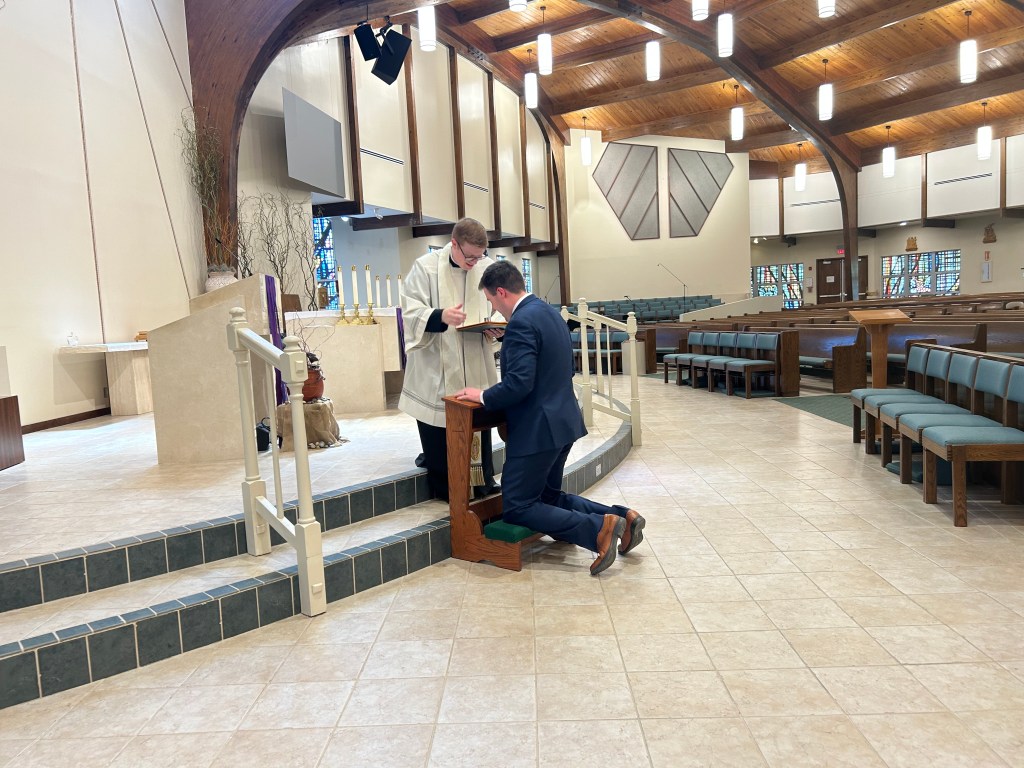
I wish I could say that I have all the answers; it would make not only writing these posts easier, but I would have won the lottery about 600 times by now if I did. However, I do not. Which is why, to answer the cliffhanger question I left in my last post—how can we still honor our parents when we do not obey them?—I reached out to my priest, Father Zack.
I will talk more about Father Zack in a future post, but suffice to say for now that he was the one who brought me in to the Catholic Church over my protests and arguments while I was still a member of the NICOC. Interestingly, he recently turned 30, which has been extremely useful to me because it means we are both at the same stage of life. Sometimes it is helpful to talk with someone who can relate directly to what you are discussing from present experience rather than past.
So I scheduled a sit-down with him one Thursday afternoon at his parish office. Opening up to him about this subject was more difficult than I initially anticipated. I do not know why I did not anticipate this, since my relationship with my parents has always been a secret thing, and something of a sore spot. Somehow, though, I was caught unprepared and thus fumbled about for words at the start of our session. I wanted to provide some backstory to explain my current predicament, but being a lawyer knew that too much backstory can detract from the main purpose of one’s narrative. So I tried to wrap up my entire familial history of over thirty years in five minutes so we could move on to the main event.[1]
“How can I honor my parents while refusing to obey them?”
At first, Father Zack turned my attention to places in the Bible with which I was already familiar. He mentioned that, as a grown man with a wife and children, I was Biblically separated from my parents and joined to my wife. He also noted that I was not obligated to follow them in spiritual matters if I believed them to be incorrect, since our obligation to God is greater than to our parents.
“I understand all that. But what I mean is, what does ‘honor’ look like if not obedience? It is easy to honor my parents—in my mind at least—if I just do everything they say. It gets a lot harder if I am not doing what they want and they are effectively threatening to cut me and my family out of their lives. It feels like I am breaking God’s commandment when they react like that.”
With this clarity, Father Zack turned my attention to the verse I was referencing: Exodus 20:12. “Honor thy father and thy mother.”
“You’re a lawyer, so you’ll appreciate this: this commandment is both an obligation and a right.”
I might be a lawyer, but that does not mean I am very smart. “You’ll need to run that by me again.”
“This commandment orders you to honor your mother and father—that’s the obligation. However, it also assumes something: that you have the right to a mother and father. You have a right to people who treat you as mother and father.”
“Okay, but I have parents. That’s why I’m here.”
“But are they acting as your parents?” I know I must have looked confused at that question, because he continued. “Daniel, ‘honor,’ as used in this commandment, isn’t slavery. If your parents expect blind obedience to their will over your own, they are not treating you as their child; they’re treating you like a slave.”
I had never thought about it this way before, but the logic concerning the Scripture made sense. After all, the commandment was clearly directed toward those who act as our mother and father. If one was adopted, it can be assumed they would be expected to honor their adopted parents, not their birth ones. Because we are expected to honor those who act as our parents, if no one does, then no honor is due in that circumstance.
“Even if they have acted like your parents in other ways, you can honor your parents by praying for them and holding out hope for them, but that does not mean you do what they want. If they were bank robbers, would you ‘honor’ them by helping them pull off a heist?”
“Of course not,” I answered.
“But the commandment to honor them remains, so how would you do it?”
“Probably by praying for them and hoping they saw the light.”
“Exactly.”
He also made an important point regarding obedience. “Even if they wanted you to obey them in doing something that isn’t necessarily unscriptural, but something you thought unwise, as an adult man with a family you are not commanded to obey them.”
At this point my old NICOC instincts kicked in. “Ephesians 6:1 does not say ‘obey your parents until you reach a certain age or get married, Father.’”
“No,” he agreed, “but the Greek word used in that Scripture is hypakouo—the meaning of which is ‘to listen.’ So as a child of your parents, you are ordered to hear what they have to say, but as you get older and understand better the circumstances around your life better than your parents, you may not need to follow their advice. It may not be wise to do so.”[2]
Again, this made sense to me. I currently have a five-year-old son and a one-year-old son. As of now, I know pretty much everything going on in their lives. On top of that, if you did not know, kids are dumb. Those two facts combined mean that I am better-suited than they are in determining how they should live their lives.
However, in thirty years, if I have done my job right, they will hopefully be mature, grown men with lives and families of their own outside of my direct oversight. At that point I hope they still see me as a trusted counselor and advisor in their major life decisions, but I also hope and pray they will be competent enough to ultimately make up their own minds on what is best. I will always be there for my children, and happy to provide a guiding hand, but the goal of a parent is to push the children out of the nest and watch them soar higher than you ever did. They will not do that if you always fly above them, beating them down under your wing.
That was a bit of a tangent, but I find my above line of logic comforting and sensical and wanted to share it with anyone who may be struggling in the same ways I am.
With that, my conversation with Father Zack was complete, and I had my answer. In the conversion process, if one’s family is being difficult, you are certainly not obligated to obey their wishes for your spiritual state if those wishes go against what God tells you to do. Further, our parents are not owed honor if they are not acting as our parents, but rather as taskmasters. Even if they are owed honor, however, honor is not the same as obedience—it should instead take the form of talking with them, praying for them, and holding out hope that they eventually will see the truth.[3]
[1] There is more to the story between me and my parents than just the move to Catholicism. However, my joining the Catholic Church was a major catalyst for other issues which have recently arisen. For the sake of maintaining narrative simplicity, and personal privacy, I have pared down and edited my conversation with Father Zack to focus on my conversion—leaving out the other issues.
[2] Quick note: I double-checked Father Zack after our meeting. He is right that the primary meaning of hypakouo is “to listen.” However, the secondary meaning is essentially “to obey” as we understand it. Still, I agree with his point that the commandment’s likely meaning is to hear our parents. It is especially true for adults, as we are told by Paul that, “When I was a child, I spake as a child, I understood as a child, I thought as a child: but when I became a man, I put away childish things.” 1 Corinthians 13:11. We must put away our childish thinking that our parents are infallible and always right if we are to put away childish things and “work out [our] own salvation with fear and trembling.” Philippians 2:12. If Paul did what his parents wanted, after all, he would not have become a Christian at all!
[3] The above conversation with Father Zack was, as mentioned, pared down for privacy reasons. I also want to note that some of the dialogue was restated differently than it was said in the moment. Mostly because I was not taking copious notes during our conversation, so I am having to recreate the highlights from memory. Also, though, because I want to ensure clarity for the reader of Father Zack’s points. That likely would be muddled if my frequent interruptions to what he was saying were included.
 The Crossroads Commentary
Leave a comment