
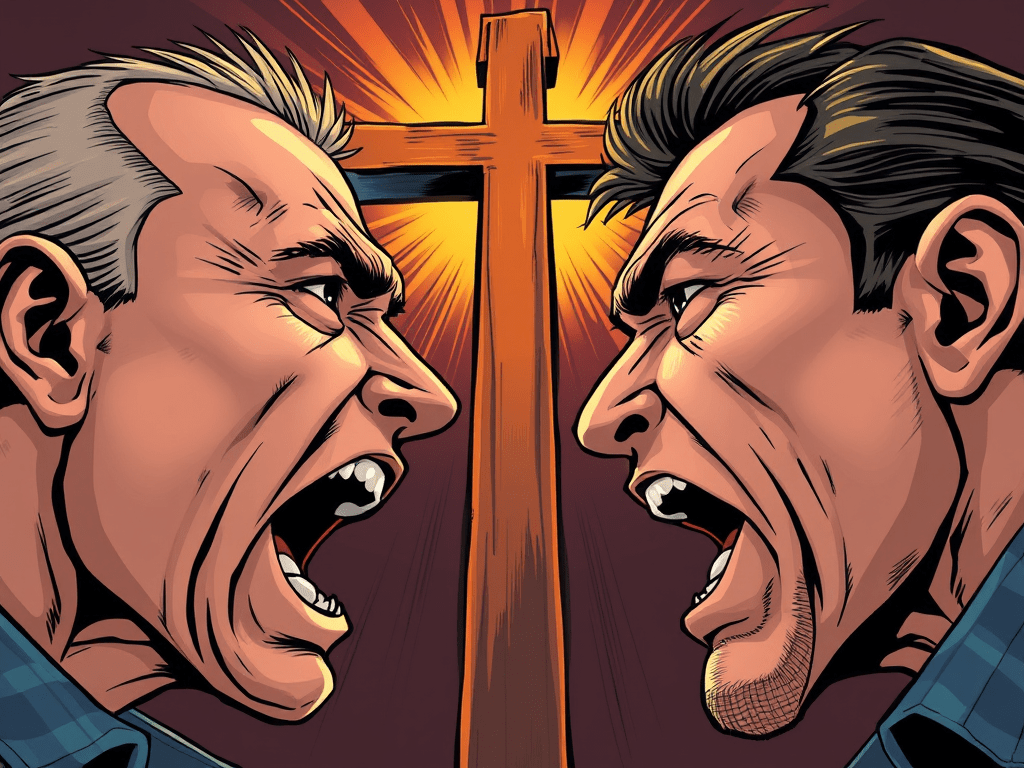
A couple of weeks ago, I announced via a social media post that I had become a member of the Church.[1] While I had not shied away from this truth with my parents or those who knew me in-person, I will admit I was worried to take this particular step because social media includes not just those people who know you now, but also people who may have known you at one season in your life. To receive such a jarring update after maybe not having interacted with me in decades was sure to be a shock, and being the one to cause such a shock definitely made me hesitate.
Ultimately, though, I realized that either I had to make the announcement, or wait for someone else to make it for me. When looked at through that lens, I quickly realized there was no other choice to be made.
At the end of the post, I mentioned that while I was not willing to debate my decision, I was happy to discuss it.
The reason for this is simple. My old sect, the NICOC, comes from a rich tradition of debate. Having emerged on the western American frontier in the early nineteenth-century, from day one the church of Christ had to justify their existence and scrap for survival in a religiously pluralistic world.[2] As part of the Second Great Awakening and Restoration movement, they were having to do this while also separating themselves from fellow Restorationist movements like the Jehovah’s Witnesses and Church of Christ of Latter Day Saints. The best way the founders of the movement had to do this was to set-up shop and debate with the Baptists, Presbyterians, and Methodists that surrounded them. That tradition of debate continues to this day, albeit in a much watered-down form.[3] However, growing up in the church of Christ I found that our style of debate left little room for the truth. It was all really about who could pull a proof text faster to steelman their position while straw-manning their opponent’s. A good example of this would be classes we in the church of Christ would take learning about other faith traditions and why they were wrong. I remember a slide explaining how Catholics pray to statues and believe the Pope is infallible. This is, of course, false, but little snippets of (mis)information like that proved invaluable in my time in the church of Christ when working to undermine the faiths of others while trying to bring them to my side. You may see where I’m headed with my aversion to debating people like this.
Someone wrote to me after I put up my post accusing me of, essentially, being a bad attorney for not wanting to debate. First, if anyone reading this wants me to argue as an attorney with them, then I will gladly oblige. My fee is $500 an hour, so just have the check ready. Second, though, and more seriously, it is exactly because of my profession that I have little faith in church of Christ debate as a means to come to the truth. As an attorney, I have seen firsthand how little of argumentation is about finding the truth when passions are inflamed. Rather, antagonistic debate—the church of Christ’s specialty during my time in it—is all about winning at any cost.
This is not to say that all debate is bad. St. Paul routinely debated the merits of the Christian faith throughout his ministry.[4] However, such debate must come from a genuine desire to find truth; not win. We see in the Scriptures how Paul worked to meet people where they were at. He had Timothy circumcised so he could preach more effectively to the Jews.[5] He explained that God existed and was being honored, though ineffectively, by the Greeks already.[6]
“For though I be free from all men, yet have I made myself servant unto all, that I might gain the more. And unto the Jews I became as a Jew, that I might gain the Jews; to them that are under the law, as under the law, that I might gain them that are under the law; To them that are without law, as without law, (being not without law to God, but under the law to Christ,) that I might gain them that are without law. To the weak became I as weak, that I might gain the weak: I am made all things to all men, that I might by all means save some. And this I do for the gospel’s sake, that I might be partaker thereof with you.”[7]
Again, given the rough-and-tumble start of the church of Christ, losing was not an option at its inception. To lose would have meant to be swallowed back into Presbyterianism and Baptism. Thus, the church of Christ could not, and cannot, afford to be “all things to all men” because to do so would be to deny the sectarian exclusivity that it claims to have.
Pilate famously asked Jesus, “What is truth?”[8] While that is a loaded question, I am certain truth cannot be found in antagonistic debate. If it could, the United States would be the most peaceable place on Earth. Rather, antagonistic debate foments anger and obscures the light of reason in exchange for soundbites and snark.
Still, though, I’m not perfect. I received some messages with many of the arguments I had already defeated in previous interactions. Even still, some things caught my eye that I couldn’t ignore, and which show why debating to win is a dangerous prospect when it comes to theology.
In refuting the Church, this individual wrote the following:
“I had many conversations with devout Sunnis. They believed that the Catholic church was the only Christian faith, and that influence played a huge role in their rejection of Christ. According to Sunnis, the Papacy does not follow the teachings of its own Bible. They have some very strong arguments using our Bible. But, it is a lot like the pot calling the kettle black.”[9]
Although this individual seems to admit at the end that it is a weak position to depend upon the opinions of non-Christians to decide upon the correct doctrine of Christ, he still does. This is what antagonistic debate lends itself to: desperately searching for any toehold by which you can claim authority over your opponent. Because the church of Christ in particular has no authority beyond the individual, the need for validation can result in turning to non-Christian opinion to disprove contrary thought. Frankly, though, I would rather be the kind of Christian non-Christians, including Muslims, disagree with theologically, than the alternative. We are called to be different from the world.[10] If the world’s religions find us agreeable, we are doing something wrong.[11] Further, it is dangerous to rely upon non-Christian opinions to discern Christ’s doctrine. When we rely on non-Christian opinion to inform our opinion on Christ’s Church, it will invariably lead us away from it, because non-Christian opinion is the opinion of the world, with which we are ordered not to conform. Regardless, the above is a good example of why antagonistic debate is dangerous; out of desperation to win we may end up aligning with those from whom we are called to be separate.
The same individual then wrote the following:
“Daniel, you’ve handled this poorly . . . pivoting toward a ‘religion’ that insists tradition (we know how much Jesus loved traditions) and magisterium, occupy equal space in the foundation of the church with the Word of God…just like John 1:1 teaches;‘In the beginning was the Magisterium, and the Magisterium was with God, and the Magisterium was God.’”[12]
This statement alarmed me. First, we as Christians are in fact called to observe traditions, both written and orally passed on by the Apostles.[13] Second, for reference, John 1:1 actually states: “In the beginning was the Word, and the Word was with God, and the Word was God.” In verse 14, the Apostle John goes on to write: “And the Word was made flesh and dwelt among us . . . .” This is not a coincidence. St. John explicitly states at the end of his book that “these are written that you may believe that Jesus is the Christ, the Son of God, and that believing you may have life in his name.”[14] The purpose of stating the Word was God and made flesh is to draw attention to the divinity of Christ. The book of John is among the strongest direct Scriptural supports we have from the Apostles of Christ’s Godhood. To deny his Godhood is, of course, to deny Christianity itself.
However, this person’s message seemed to imply that “the Word” mentioned in John 1:1 was referencing Scripture, rather than Christ. This is because the Church teaches that its three pillars are Sacred Scripture, the Magisterium, and sacred Tradition.[15] By replacing “the Word” with “the Magisterium” my opponent was saying that the Church puts its teaching on equal footing with Scripture. However, as noted above, John 1 is not talking about Scripture at all when it says “the Word,” but Christ. In fact, if it was talking about Scripture, that would be a blow against Christ’s divinity. This is actually an argument espoused by Muslims to this day to deny the Godhood of Christ.[16]
I assumed my opponent was just trying to get some snark in and hadn’t thought through what he wrote. I told him as much: “Come on . . . you know better. The Word in John 1 is Jesus, not the Bible, which had not even been fully written at the time John 1 was written (given that John is, you know, part of the Bible).” To my astonishment, though, my opponent did not back down from his position, but rather doubled down in his response, stating:
“Roman Catholicism attempts to invoke doubt on the veracity of Scripture by claiming phrases like: ‘the Bible wasn’t even written when John said that,’ as though the Holy Spirit is inept. Paul tells us what the Scriptures are good for…no side stepping that. And you need to dig into that interlinear Bible and get to the bottom of that term ‘Word’ as used in John.”
The point of this article is to note the dangers of antagonistic theological debate, not to dig deeply into the theology laid out above. That being said, “Word” as used in John 1 is derived from the Greek word logos. Experts in the Church have analyzed its use, and I will put their words in the endnote below.[17] But you do not have to be an expert in Greek to realize that when John 1:14 tells us, “And the Word became flesh and dwelt among us, full of grace and truth; we have beheld his glory, glory as of the only-begotten Son from the Father,” that it’s not talking about some pages in a book. It’s talking about Christ. Further, if you needed to be an expert in Greek to understand the meaning of “the Word,” or needed an interlinear Bible as my opponent suggested, then that would defeat the “Bible alone” mentality he espouses, because according to him, then, you actually do need outside authority to understand Scripture. Just not the Church.
It is troubling that my opponent seemed to disagree that “the Word” was obviously referring to Christ. Now, do I think my opponent is an undercover Arian denying the divinity of Christ? No, of course not, although Arianism is an issue within the church of Christ. I personally watched a once-prosperous congregation in Dallas split over this evil. Instead, though, I think my opponent was inflamed—my snark that you read above certainly didn’t help in that regard—so he said something stupid and heretical by mistake. However, both my snark and his heresy serve my goal of illustrating why we must be careful when debating theology. Again, it is not wrong to do so, but if we are solely doing it antagonistically with the mindset to win rather than find truth, we may end up betraying the very beliefs we claim to hold dear all for a chance at temporal victory.
“For what shall it profit a man, if he shall gain the whole world, and lose his own soul?”[18]
[1] https://www.facebook.com/daniel.anthony.876737/
[2] I am not going to cite every sentence that relates to the history of the church of Christ. However, rest assured 99% of my remarks are sourced in an excellent book I have been reading entitled Reviving the Ancient Faith, 3rd Edition: The Story of Churches of Christ in America, by Richard T. Hughes from Pepperdine, and James L. Gorman from Abilene Christian University. You can buy it on Kindle.
[3] Debates are now mainly comprised of arguments with the local Baptist congregation concerning whether or not baptism saves us (funny enough, the Church and the church of Christ agree that it does). https://www.facebook.com/jackwilkie89/posts/pfbid02wZQpV2dT1ac3pNrWszMjUWHQt4r8QufETC1QWfNDgM7KwWRjLfMaV8tA2obYhdupl?rdid=ybkDLph9TFAyEFGP. Interestingly, I did not even need to seek this example out; it was recommended to me on my Facebook newsfeed of its own accord while writing this post. Divine providence?
[4] We see instances of debate within the Church in Acts 15:2, as well as debate with those outside the Church in verses such as Acts 17:17.
[5] Acts 16:3.
[6] Acts 17:23.
[7] 1 Corinthians 9:19–23.
[8] John 18:38.
[9] While I will omit details that lend to giving away my opponent’s identity or disclosing my own personal information, I am quoting him directly so that no one can claim I am straw-manning the opposition.
[10] Romans 12:2.
[11] St. Paul may have become all things to all men in style, but the substance of his message was always Christ’s, after all.
[12] Emphases and grammar not my own, except for the first ellipsis which was placed to avoid disclosing personal information.
[13] 2 Thessalonians 2:15.
[14] John 20:31.
[15] CCC ¶ 95.
[16] I have recently been interacting with a Muslim on X, and they made a very similar argument to deny the divinity of Christ. You can check out the interaction here: https://x.com/Zeeshankhan2778/status/2014909278751228353. He stated: “‘In the beginning was the Word’ means that Allah’s books were written even before revelation. ‘The Word was with God’ means these books were with Allah before being shared with humans. ‘The Word was God’ means we should consider the books as divine instructions. That’s all.”
[17] “The term [logos] is used 330 times in the NT. The background of this concept in John is both philosophical and biblical. (1) Ancient Greek philosophers associated the Word with the order and design of the universe or with the intelligible expression of the mind of God as he sustains and governs it. (2) In biblical tradition the Word is the powerful utterance of God that brought all things into being at the dawn of time (Gen 1:3; Ps 33:6; Wis 9:1). (3) Another biblical tradition links the Word of God with the Wisdom of God, who was depicted as God’s eternal companion (Prov 8:23; Sir 24:9), the craftsmen who labored alongside God at creation (Prov 8:30; Wis 7:22), and the one who remains a source of life for the world (Prov 8:35). John, it seems, has pulled these traditions together to say something entirely new: the Word of God is not so much an abstract principle or an audible power as it is a Divine Person: God the Son (Rev 19:13). This eternal Word, once a mediator of creation, has now become a mediator of salvation through his Incarnation (Jn 1:14; 3:17).” Ignatius Press Study Bible, page 1887.
[18] Mark 8:36.
 The Crossroads Commentary
Leave a comment